
Have you ever wondered how a plant like cannabis can affect each person differently? How can cannabis help one person sleep better, another feel less discomfort, someone else regain an appetite, and another feel more peaceful and serene? Could cannabis be magic? Not quite. The answer lies within you.
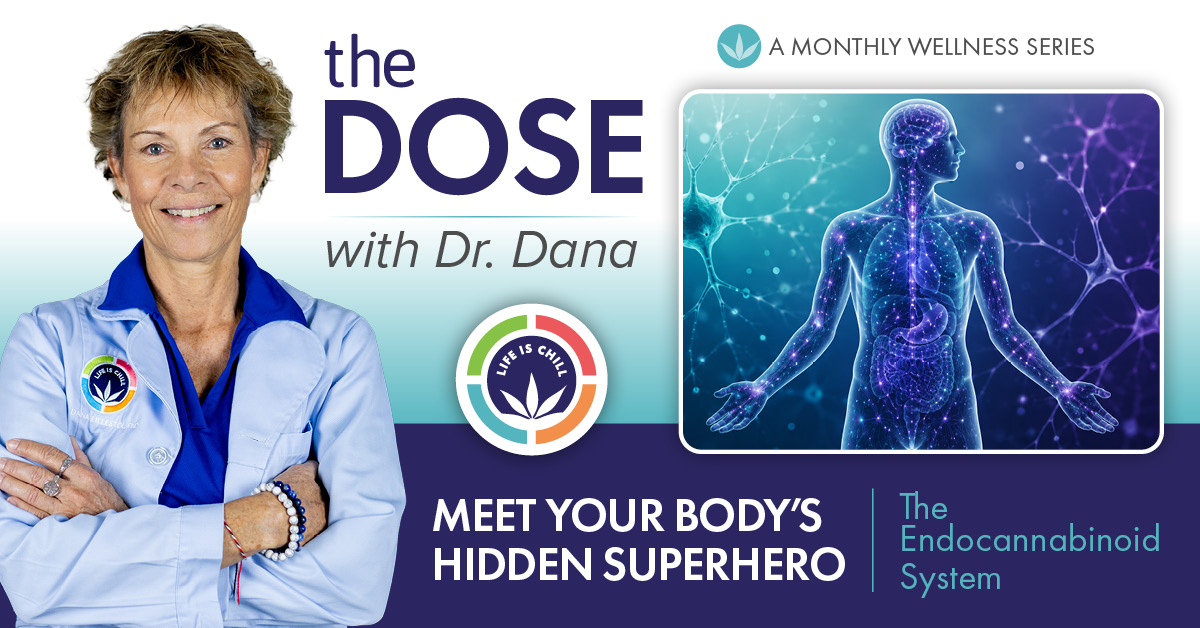
Long before anyone discovered cannabis, your body had a built-in communication network to help keep you healthy and balanced. Scientists call it the Endocannabinoid System (ECS). Although the ECS was not discovered until the early 1990s, researchers now believe it is one of the body’s most important regulatory systems. Think of the ECS as your internal orchestra conductor, making sure every section or compartment plays in harmony.
Your Body Loves Balance
Your body is constantly trying to maintain something scientists call homeostasis. That is a big word for balance. Too hot? Your body cools down. Too cold? It warms you up. Your body tries to calm itself. Too little sleep? It nudges you toward rest.
The ECS works behind the scenes every second of every day, assisting your body to stay in that “just right” zone. Imagine Goldilocks walking through your body saying: “Not too much… not too little…just right.”
The Two Parts of The Endocannabinoid System
Like any great team, the ECS has two important players. Each player is dynamic and strategic.
The Endocannabinoids: Your Body’s Homemade Helpers
Your body makes its own cannabis-like molecules. Yes, you read that correctly! These naturally occurring messengers are called endocannabinoids. These are tiny molecules your body makes naturally. The two best-known are:
- Anandamide—often nicknamed the “bliss molecule” from Sanskrit
- 2-AG (2-arachidonoylglycerol)
Unlike hormones that are stored until needed, endocannabinoids are produced on demand, like calling the fire department only when smoke appears. Their job? Carry messages that help restore balance.
Receptors: Tiny Locks Waiting for the Right Key
Every human or mammal has an internal system that regulates cellular activity. It is found in the cannabinoid receptors that are interspersed throughout the body. CB1 receptors are especially abundant in the brain and nervous system, including regions involved in memory, movement, reward, appetite, pain processing, and coordination.
They also occur in peripheral tissues. Think of CB1 as the nervous system’s volume knob. The shorthand for CB1 equates to “brain.”
CB2 receptors are strongly associated with immune cells and peripheral tissues, but they are also found in parts of the nervous system, particularly in immune-like cells such as the microglia in the brain. Think of CB2 as the “body.” Think of CB2 receptors as the body’s neighborhood peacekeepers. When the body experiences high levels of inflammation, CB2 receptors help encourage the immune system to settle down. Researchers continue to investigate CB2 for its helpfulness in combating the following: neuropathic pain, immune disorders, and inflammation.
Behind the scenes are the enzymes. These substances are the clean-up committee, they clear off the cell membranes and help the body eliminate any excess
cannabis that cannot be absorbed.
Why Older Adults May Respond Differently
As we age, several physiological changes usually occur. Our bodies experience changes in:
- Hormone production
- Immune function
- Metabolism
- Sleep quality
- Pain processing
- Medication use
The endocannabinoid system also appears to change with age, although scientists are still studying exactly how these changes influence health and responses to cannabis. Some older adults report benefits from carefully selected cannabis products, while others experience unwanted side effects such as dizziness, sedation, or confusion.
So, the golden rule is: Start low. Go Slow. Stay Informed.
Veterans: Why the ECS Matters
Veterans often face health challenges including chronic pain, disrupted sleep, anxiety, and the lingering effects of injuries. The ECS plays a critical role in the peaceful regulation of these physical challenges.
Researchers are actively studying cannabinoids for conditions such as chronic pain, sleep disturbances, and symptoms related to post-traumatic stress disorder (PTSD). Some studies suggest potential benefits for certain individuals, but results are mixed, and cannabis is not considered a first-line treatment for PTSD. If you are considering cannabis, discuss it with a healthcare professional—especially if you take prescription medications or have heart, liver, or mental health conditions.
Final Thoughts
The endocannabinoid system may be one of the most important biological systems most people have never heard of. Every day, it works quietly behind the scenes to help regulate mood, pain, sleep, appetite, memory, immune function, and overall balance.
Cannabis affects us because its cannabinoids can interact with this remarkable system—especially the CB1 receptor in the brain and CB2 receptors throughout the immune system and body.
Your body did not develop CB1 and CB2 receptors because cannabis exists. It has its own endocannabinoids because the ECS is part of normal human physiology. Cannabis happens to contain molecules capable of interacting with that ancient signaling network.
As research continues, we’re learning that cannabis isn’t simply “getting high.” It’s about understanding a sophisticated biological network that influences many aspects of human health.
For older adults and veterans, knowledge is empowering. The more we understand how the endocannabinoid system works, the better equipped we are to make informed decisions about wellness, always in partnership with trusted healthcare professionals. After all, healthy aging isn’t about turning back the clock—it’s about helping your body’s orchestra play in tune for as long as possible.
References
National Academies of Sciences, Engineering, and Medicine. (2017). The Health Effects of Cannabis and Cannabinoids: The Current State of Evidence and Recommendations for Research. Washington, DC: National Academies Press. Retrieved August 5, 2026, at https://www.ncbi.nlm.nih.gov/books/NBK423845/.
Pertwee RG. The pharmacology of cannabinoid receptors and their ligands. Handbook of Experimental Pharmacology. 2015. Retrieved August 18, 2026, at https://pubmed.ncbi.nlm.nih.gov/16570099/.
Lu HC, Mackie K. An Introduction to the Endogenous Cannabinoid System. Biological Psychiatry.2016;79(7):516-525. Retrieved August 8, 2026, at https://pubmed.ncbi.nlm.nih.gov/26698193/.
Zou S, Kumar U. (2018). Cannabinoid Receptors and the Endocannabinoid System: Signaling and Function in the Central Nervous System. International Journal of Molecular Sciences, 19(3):833. Retrieved August 20, 2026, at https://www.mdpi.com/1422-0067/19/3/833.
Iffland K, Grotenhermen, F. (2017). An Update on Safety and Side Effects of Cannabidiol. Cannabis and Cannabinoid Research, 2(1):139-154. Retrieved August 10, 2026, at https://pubmed.ncbi.nlm.nih.gov/28861514/.
U.S. National Institutes of Health, National Center for Complementary and Integrative Health. Cannabis (Marijuana) and Cannabinoids. Retrieved August 15, 2026, at https://www.nccih.nih.gov/health/cannabis-marijuana-and-cannabinoids-what-you-need-to-know.
Veterans of Foreign Wars. (2021, September). Federal study finds cannabis is beneficial among PTSD patients receiving cannabis doses for higher levels of THC. Retrieved August 16, 2026, at https://www.vfw.org/media-and-events/latest-releases/archives/2021/9/federal-study-finds-cannabis-beneficial-for-ptsd-treatment.